What Warsh's First Meeting Tells Us About the Rest of 2026
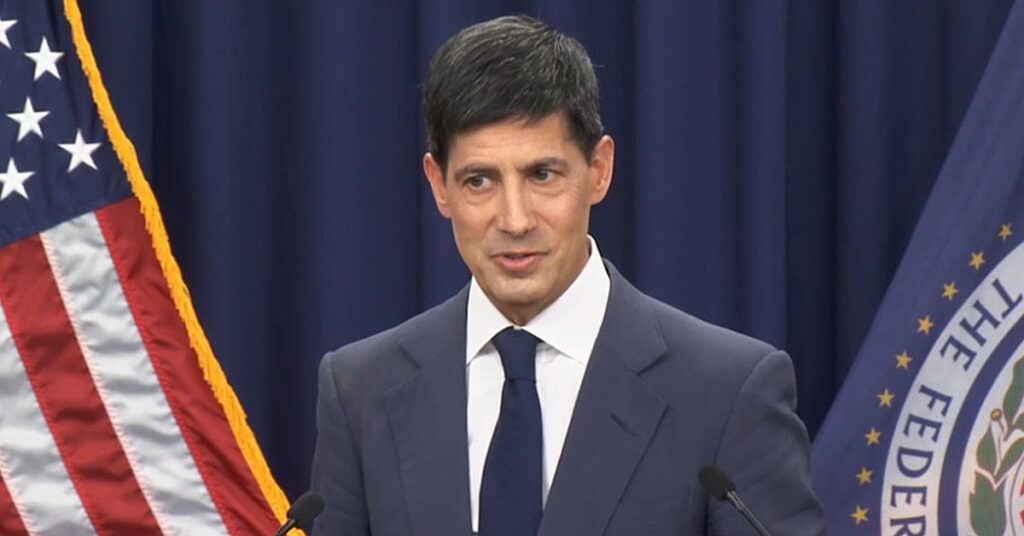
Kevin Warsh was confirmed on May 13 as the 17th chair of the Federal Reserve in a 54–45 Senate vote, the most divisive confirmation in Fed history. He inherited a genuinely difficult hand. Inflation reached a three-year high, hiring had been slowing for months even as layoffs stayed relatively low, and April's FOMC meeting had produced the most policy disagreement among committee members since 1992. That internal fracture doesn't simply heal when leadership changes. Warsh has publicly called for lower interest rates several times, but was unequivocal when asked whether Trump had pressured him. Warsh's first FOMC meeting ended with a unanimous vote to hold the federal funds rate at 3.50%–3.75%, however, the key takeaway was that Warsh declined to offer his own personal interest rate projections, something markets typically expected of former Fed Chair Jerome Powell. This is where Warsh's chairmanship represents the sharpest break from the Powell era. Warsh has been broadly skeptical of "forward guidance," fearing it ties the central bank's hands. It's one of the most significant stylistic shifts in Fed communication in decades, and financial markets will have to adjust. It does not come at a surprise that stocks slid upon this shift, and markets quickly gained some back the following day.

2026 FIFA World Cup comes to North America
FIFA projects a $17 billion boost to U.S. GDP and the creation of 185,000 jobs from the tournament. Zooming out to the full North American picture, FIFA projects the 2026 tournament will generate $40.9 billion in GDP across North America, with U.S. host cities seeing $160–$620 million in incremental economic activity per city. Visitors are expected to spend over $5,000 per person, roughly 1.7 times the typical international traveler. For context on scale, New York's tourism chief described it as "the equivalent of six or seven or eight Super Bowls within a six-week period." OVerall, the global sporting event is expected to bring a short-term GDP lift.

Stocks continue rally into the summer
Stocks continue their rally off the March lows into the summer; below is an overview of the strongest sectors YTD: - Technology +32% - Industrial +17% - Energy +22% - Healthcare +12% - Consumer Discretionary +11% - Utilities +11% - Financials +7% - Consumer Stapes +4% - Communication Services +6% The catalyst was AI, as it has been for much of the past three years. Major players like Nvidia, Google, and Broadcom significantly boosted the index, with substantial growth also seen in companies like Bloom Energy, SanDisk, and Micron which surged due to their involvement in AI technologies. Nvidia alone climbed more than 6% in a single session after unveiling a new processor for personal computers in early June, with CEO Jensen Huang calling it "as big a deal as the reinvention of the phone into the smartphone. Arguably the most underappreciated sector winner, Industrials, are being supported by increased capital spending in key growth areas like electricity capacity, construction around the AI infrastructure buildout, defense, and energy. The growth in AI-driven capex is rippling across sectors as companies race to build and connect mega-scale data centers, surging energy demand is fueling a "power renaissance." These data centers target gigawatt-level power loads comparable to the electricity needs of a small city, and carry price tags well into the tens of billions of dollars. Healthcare is structurally supported by increasing health awareness, technological innovation, and demographic trends including an aging population. Relatively steady demand characteristics may provide defensive positioning during economic uncertainty. Healthcare is expected to benefit from technological advances and improving operational efficiencies from drug discovery acceleration to hospital workflow automation. For Utilities, the AI connection is real and growing. Domestic-focused power infrastructure and solar players can benefit from structural growth drivers like AI data center expansion, industrial expansion, and the energy transition. The utilities sector has non-cyclical demand characteristics providing defensive positioning during economic uncertainty. As markets head into the back half of 2026, the bull case rests on a set of conditions: that the Iran peace deal holds and energy prices continue to ease, that AI earnings justify the valuations tech has accumulated, and that markets can adjust to new Fed's economic approach. A positive outcome would mean much more broadened returns across the market.
Apple–Intel: The partnership that could reshape the semiconductor world
The announcement came the way much of President Trump's economic policy does: via Truth Social. Last week, Trump posted that Apple had agreed to work with Intel to design and manufacture chips on American soil. The market reaction was instantaneous. Intel shares jumped as much as 12% on the news. The strategic logic is straightforward: the U.S. cannot allow TSMC to remain the sole source of its most advanced chips, particularly in an era of heightened U.S–China tensions and the demonstrated fragility of globally distributed supply chains. By actively facilitating deals between Intel and Apple, Nvidia, and Tesla, the administration is effectively using commercial relationships as a tool of industrial and national security policy.